

 Indonesia is the world’s largest exporter of sharks and rays, accounting for 15% of world trade. The industry makes a significant contribution to the economy and the job market.
Yet despite the environmental, economic and social importance of sharks and rays, there is no legislation governing their sustainable management or harvesting in Indonesia. Despite volunteering to implement the FAO’s International Plan of Action for the Conservation and Management of Sharks in 2000, Indonesia has yet to implement a National Plan of Action.
Recently we wrote about the increasing trend for unregulated fishing for juvenile and undersized sharks, and questioned the sustainability of this practice. We wondered how this industry affects manta conservation and shark conservation? We asked how small is too small?
But now we wonder how big is too big?
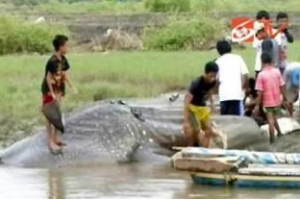
Last week the Jakarta Globe reported on fishermen in eastern Indonesia who recently caught a 15 m whale shark.
This is a species listed as vulnerable on the IUCN’s Red List. It is also a huge draw for tourists dollars.
So how big is too big? Is small-scale subsistence fishing for whale sharks sustainable? Is it responsible governance to have zero legislation governing species that are environmentally, economically and socially so important in Indonesia? Let us know your thought below.