
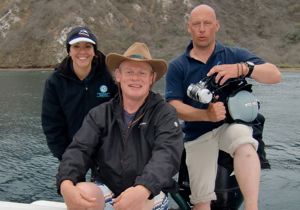

Martin Clunes searched for mantas for 8 days
English actor Martin Clunes has fulfilled a burning ambition to swim with manta rays. Along the way he faced not only his fear of diving, but also the gruesome reality of manta ray conservation (UK ITV1 Man to Mantas).
“Three years ago I had a bad experience underwater and I’ve been nervous about diving ever since,” says Clunes.
“I had a panic attack whilst diving off the coast of Scotland for a documentary about islands.
“The water was freezing cold and murky. The worst thing was, so that I could talk to the camera underwater, I was wearing a goldfish bowl of a mask and a respirator. This goldfish bowl was full of air and it kept lifting up and pulling the whole suit up around my chin in a very disconcerting way.
“I couldn’t regulate my breathing, and I completely freaked, and had to ask one of the safety crew to take me up to the surface. It was horrible.”
Clunes admits that he didn’t think he would ever dive again. For three years he wouldn’t venture beneath the water, but a burning ambition drew him back.
“There’s just one creature in the ocean which I’ve always truly wanted to see. The mysterious, magical and elusive manta ray,” Clunes explains.
Clunes set off to realise his ambition for UK ITV’s new documentary Man to Mantas. His search for this elusive creature took him to the Maldives, where the government has banned the export of all manta ray products. In 2009 a marine protected area was declared around the island of Hanifaru, protecting mantas from fishing pressure.
For seven days Clunes dived every day but did not see a single manta. However on the eighth day, his luck was to change.
“It was the tenth day of the tenth month, and the tenth reel of film in the camera. It must have been an omen.The manta rays came so close I could almost touch them. It was amazing. There were about 3 or 4 of them just gliding over us, so close, so unworried by us. I had faith that the mantas wouldn’t hurt me. I had enough people telling me they were completely safe.”
At high tide Clunes returned to the bay and was rewarded by seeing 20 mantas, which swam towards him and underneath him as he snorkelled.
“It was manta heaven in there,” he says.
After this magical experience, Clunes travelled 300 miles to nearby Sri Lanka, where he was shocked to witness the booming business in fishing for manta rays.
Clunes visited a fish market in Mirissa, where manta rays are known to be bought and sold to feed a growing demand for use in Chinese medicine. The manta rays are hacked apart for the gill rakers, the black filters along the underside of the rays’ torso that help them breathe underwater. The gill rakers are dried and turned to powder used to purify the blood.
“What I saw in Sri Lanka was truly gruesome. You can’t blame the local fisherman, especially after the devastating effects of the Tsunami.
“But without a solution to this, the consequences for the manta ray population in the Indian Ocean could be catastrophic.
“From making this film, I learnt quite a lot, and not just about manta rays, but the underwater world, and how it is being plundered in an unsustained way. The way pregnant sharks and their babies are being killed; it does not make sense for their own business. I am not sure what the answer is.”
What is the answer to sustainable manta ray fisheries? Share your views [intlink id=”286″ type=”post”]in our poll[/intlink], or have your say in the comments below.
Martin Clunes’ Man to Mantas will air on Thursday 6th January 2010 on UK ITV1.