
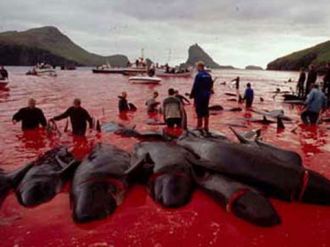
Annual Faroe Islands whale hunt
After 85 years of controversy, commercial whaling may finally be in decline. What lessons can be learned from the whaling saga to aid manta ray conservation?
As early as 1925 the League of Nations raised concerns about the over-exploitation of whale stocks, and called for conservation measures. This eventually culminated in the Geneva Convention for the Regulation of Whaling coming into force in 1934.
However the Convention was completely ignored by both Japan and Germany, and for the next 70 years controversy and conflict persevered.
With growing scientific evidence that many whale populations were endangered, a variety of attempts were made to turn the tide.
Domestic laws such as the US Marine Mammal Protection Act regulated hunting, killing and trading of whales within national boundaries.
International regulations, guidelines and moratoria, such as those proposed by the International Whaling Commission, governed whaling in international waters.
Meanwhile public awareness about whaling issues grew as a result of campaigns like “Save the Whales”, and reports of direct action by groups such as Greenpeace in the headlines.
And yet commercial whaling continued, and even increased. Norway, a registered objector to the International Whaling Commission, unilaterally increased its whaling quota several times, while Japan continued to hunt whales citing scientific motives.
But now the tide may be turning. And it is not campaigns, moratoria or quotas driving the decline of whaling, but profit margins.
In Japan, the Iruka & Kujira [Dolphin & Whale] Action Network recently reported that frozen stockpiles of whale meat have reached a record high of 6000 tonnes, while Japanese consumption of whale meat wanes.
Meanwhile Japanese taxpayers are incensed at forking out US$ 9 million per year to subsidise the nation’s Antarctic whaling fleet.
With this shift in public perception and a diminishing market, the Japanese whaling fleet has been forced to change tack. Two years ago the fleet consisted of eight ships, this year it has four. Furthermore the whalers were two weeks late reaching the Antarctic, and expect to end their season one month earlier than usual, largely due to a lack of demand for their product.
The nail in the coffin may be the International Maritime Organisation’s ban on heavy fuel oils in the Antarctic starting in August 2011. Japan, one of the world’s leading maritime nations, will enforce this ban. To comply, their whaling fleet will require a major refit, and this may prove to be too costly in the current market.
Here at MantaWatch we are following this story with interest. Like the whaling campaigns, we are committed to raising awareness about manta ray conservation issues, and supporting conservation and management planning.
But we also recognise that to protect manta rays, we must first address the social and economic factors driving their decline. Without access to education, without alternative jobs and livelihoods, and without viable pro-biodiversity markets and businesses, manta ray conservation will continue to be a loosing battle.
Share your opinions in the comments below. Should the economy or the environment dictate conservation approaches? Where you inspired or turned off by “Save the Whales” or similar campaigns? Is 85 years an acceptable target for regulating manta ray fisheries? Tell us what you think.